ContextOS: memory, retrieval routing and context reasoning for agents
ContextOS is a Python MCP server and CLI that gives AI agents memory, routes retrieval by how fast data changes and adds a reasoning step between retrieval and generation. A companion benchmark tests markdown memory against RAG and graph approaches.
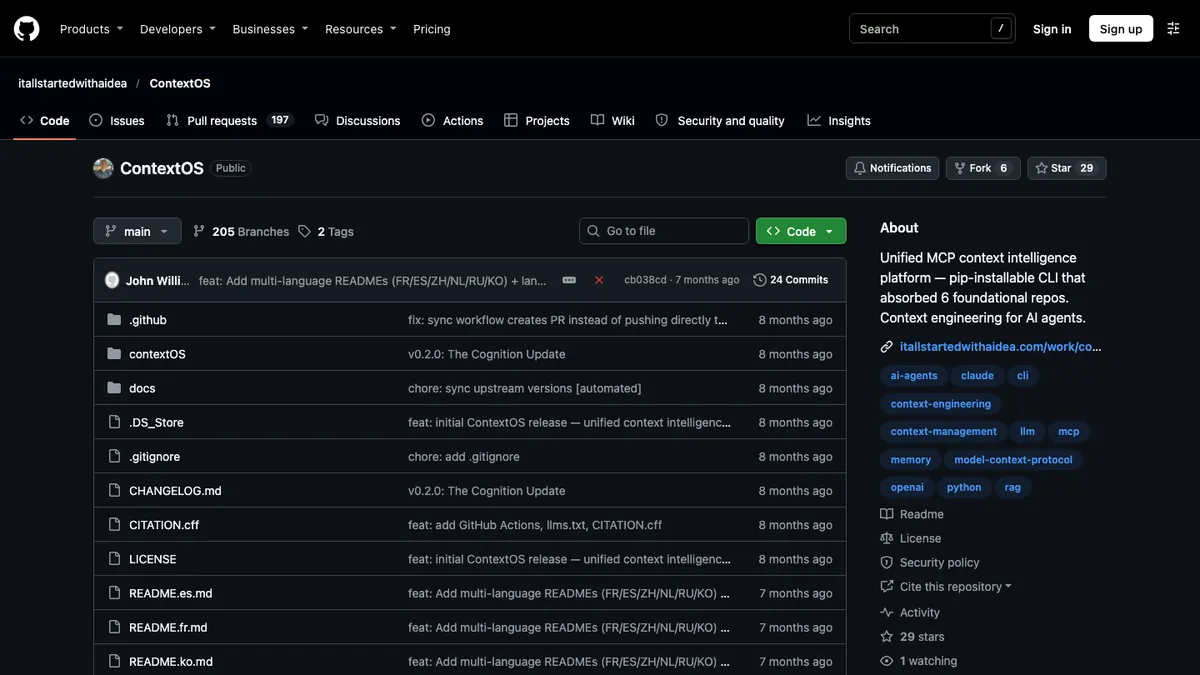
- Project
- ContextOS v0.2.0
- Built
- Mar 2026
- Code
- Public on GitHub, install from source
- Stack
- Python, MCP, BM25, vector search, GraphRAG
- Research
- Preprint on Zenodo, Mar 2026
The idea
Agent frameworks retrieve context and generate answers, but they rarely reason about what they retrieved. Memory, retrieval, planning and orchestration usually live in separate projects.
At the same time, the industry is settling on markdown files such as llms.txt as memory for language models, without much testing of how that holds up on complex, multi-step questions.
How we built it, step by step
- Built the memory and tool layerContextOS exposes 67 MCP tools in 8 groups: memory, retrieval, cognition, router, indexer, planning, orchestration and document intelligence. It builds on several open-source projects and credits them in the README.
- Routed retrieval by data churnThe Retrieval Router sorts sources into live, warm and cold. Live data is pulled from the API, warm data uses BM25 or vector search with freshness, and cold data uses full vector search.
- Kept indexes currentThe Index Lifecycle Manager re-indexes on write, detects embedding model drift, quarantines schema changes and uses circuit breakers and heartbeats.
- Added a cognition layerVersion 0.2.0 adds 6 primitives, including active forgetting, reasoning-depth calibration and productive contradiction, that run between retrieval and generation.
- Designed the Markdown Fallacy BenchmarkThe benchmark compares flat markdown, vector RAG, GraphRAG and a hybrid on a synthetic Google Ads MCC portfolio of 3 accounts and 15 campaigns. It uses 50 queries at 3 levels of difficulty across Claude Sonnet, GPT-4o and Gemini Flash.
- Published the methodScoring is deterministic, with inter-rater scripts included. The preprint is on Zenodo; the repo shows the method and predicted results, not measured ones.
What it does
- 67 MCP tools in 8 groups
- Churn-aware retrieval router
- Index lifecycle management with drift detection
- 6 cognition primitives
- Google Ads MCP as an example source
- Benchmark harness for markdown vs RAG vs GraphRAG
- CITATION.cff and wiki
How people find it
- Public GitHub repo, install from source (not on PyPI)
- MCP server for Claude, Cursor and other clients
- Zenodo preprint with DOI
- Docker compose for the benchmark
Questions people ask about this work
Is markdown or llms.txt good enough as memory for an AI agent?
That is the question our benchmark is built to test, comparing flat markdown with vector RAG, GraphRAG and a hybrid on multi-step Google Ads questions. The repo publishes the method and predicted results, not measured results yet. The preprint is on Zenodo.
How do I give an AI agent long-term memory with MCP?
Run a memory server that the agent calls as tools. ContextOS provides memory, retrieval and planning tools over MCP. Install it from the GitHub repo, since it is not on PyPI.
What is churn-aware retrieval?
It means choosing how to fetch data based on how often it changes. ContextOS pulls fast-changing data straight from the API, uses search with a freshness signal for data that changes sometimes and uses full vector search for stable data.
Services in this project
Related projects
Advertising Hub and Agent Toolkit
This is our open-source toolkit for running advertising work through AI agents.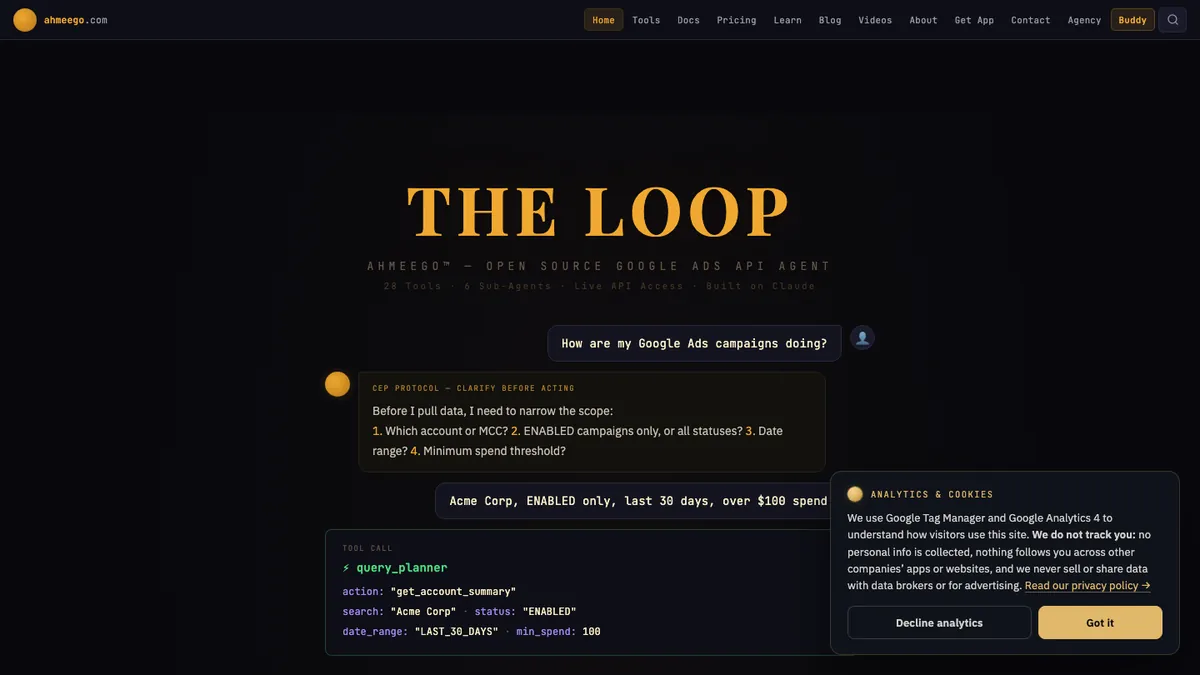
Buddy by Ahmeego
Buddy is a chat-based agent that reads a Google Ads account, stages changes, asks you to confirm them, makes them through the Google Ads API and checks the result.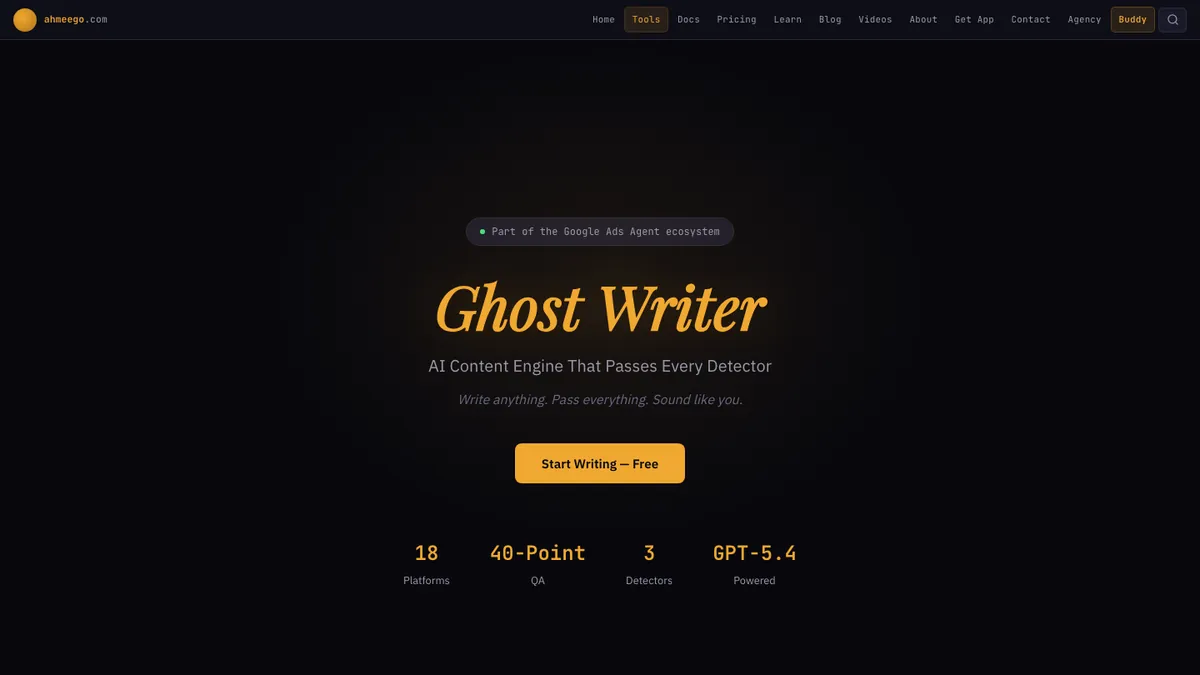
Ghost Writer
Ghost Writer drafts articles and posts from patterns studied in strong published writing, checks every draft against a 40-point QA list and revises what fails. Built and written up by John M. Williams, founder of It All Started With An Idea in Queen Creek, AZ. 15+ years and $350M+ in managed ad spend.