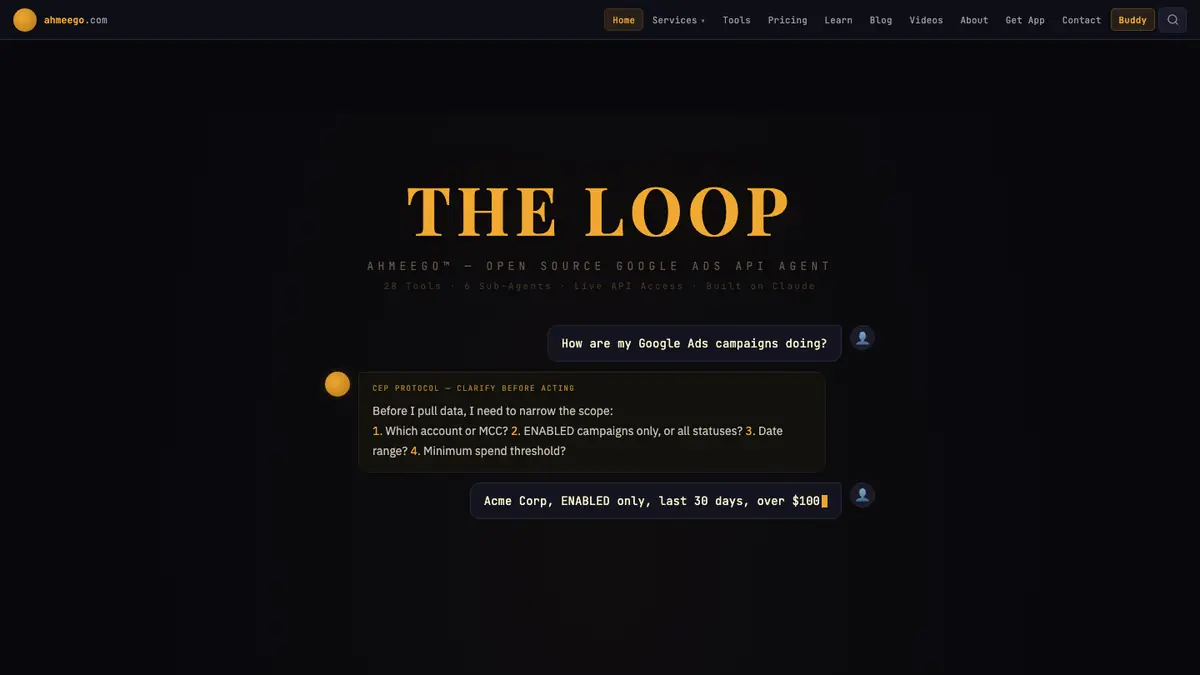
Where should a business start with AI implementation?
Start with one repetitive job your team already does by hand, write down the rules a good employee follows for it, and let AI run that playbook with a person approving anything that changes data. The first win should be boring and measurable, like flagging wasted ad spend, drafting follow-ups or routing new leads.
That is how Buddy started. Before any model was involved, the policy was a script we trusted: when search terms spend without converting, draft negatives and hold them for approval. The agent's job was to run that rule every day on time, not to invent strategy. A vague playbook gives you a vague agent.
To pick your first job, list tasks that happen weekly, follow clear rules and cost real money when they slip. Choose the one where you already know what a right answer looks like, and measure how long it takes today. If the agent cannot beat that baseline in a short pilot, we stop and move to the next one. Our Google Ads scripts are good examples of rules worth automating.
Should we build a custom AI agent or buy an AI tool?
Buy an off-the-shelf AI tool when the job is generic, like meeting notes or writing help, and build a custom agent when it has to read and act on your own systems with your own rules. The value of a business agent comes from the data it can see and the actions it is allowed to take, and no vendor knows those for you.
Custom does not mean starting from zero. We build on Claude, Gemini or OpenAI models, connect your systems through MCP servers, and reuse the open-source patterns already proven in Buddy. What gets built is the narrow part: the tool list, the permissions, the approval step and the logs. That keeps the build small and the result reviewable.
A fair warning: an agent wired to everything gets worse, not better. The more connectors you pile on, the further it drifts from what you actually asked. I'd rather ship a specialist that does one job well and add the next one later. We scope that first job and quote it as a fixed fee.
Sources: Model Context Protocol
Why do AI implementations fail?
Most AI implementations fail because the scope is too broad, nobody owns the results, or the agent gets write access before anyone has checked its judgment on real data. The model is rarely the problem. The process around it is.
Three patterns show up again and again. Context overload, where an agent is connected to every tool and loses focus, which I wrote about in the dark side of AI overload. Bad inputs, like a missing conversion tag, so the AI confidently explains numbers that are wrong. And no gate, so an agent changes live records faster than a person can catch a mistake.
The fixes are dull, and they work. Fix the data first. Give the agent a short, named list of actions. Run it in a dry loop on real data and compare its proposals with what your best person would do. Open write access one action at a time, and name the person who reviews its output each morning.
How long does it take to put an AI agent into production?
It depends on how many systems the agent touches and how clean their data is, so we scope each project and quote a fixed fee and plan instead of promising a date up front. What we can tell you is the order the work happens in, because skipping steps is what makes timelines slip.
First, the playbook and the list of allowed actions. Second, read-only connections to live data, checked against what your team sees in the real interface. Third, a dry run where the agent proposes and nothing changes. Only when those proposals match your judgment do we turn on writes, starting with the safest action. Bid, budget and customer-facing changes come last.
How long the dry run lasts is your call, and it should be. Some teams trust the proposals quickly. Others want weeks of side-by-side review. Either is fine. An agent that goes live a little later with confirm-before-write in place is worth more than one that ships fast and has to be rolled back.
How do you connect an AI agent to our CRM and internal apps securely?
We connect agents through MCP servers that expose a short list of typed tools, with read tools and write tools kept separate and every write locked behind a human approval step. The agent never gets a raw database login or a shared admin password. It gets only the fields the task needs.
For a CRM, that might mean the agent can read leads, deal stages and activity, and can draft a status change or a follow-up email, but the update only happens after someone accepts it. We keep billing, user admin and deletes out of scope entirely, cap how many changes can happen in a day, and log every proposal and approval with a label so it can be rolled back.
Ask any vendor three questions: which actions can the agent take, which ones need approval, and where is the log. If the answers are vague, the risk is real. The same rules run Buddy on live Google Ads accounts and carry over to our CRM and ERP work.
Sources: Model Context Protocol: Specification, Anthropic: Tool use with Claude
How do we measure whether AI implementation is working?
Measure the job the AI took over, not the AI itself: time saved, errors caught, money protected and how often people accept its proposals. Pick those numbers before launch and capture a baseline from how the work runs today.
For an ads agent, the scoreboard is plain. Spend on zero-conversion search terms should go down, CPA should hold steady, and there should be no surprise changes across the account. For a sales or operations agent, look at response time on new leads, records updated without rework, and hours your team gets back each week.
Watch the acceptance rate closely. If people approve most proposals with small edits, the agent understands the job. If they reject half, the playbook needs work, and that is a fix to the rules, not a reason to remove the approval step. We review these numbers with you, and sometimes the honest result is that a task is better left manual. Clean tracking from a conversion tracking audit makes the ads numbers trustworthy.