It All Started With An Idea
SEO & Web · AI Search

Be the source AI assistants cite.

When someone asks ChatGPT, Gemini, Copilot, Perplexity or Google's AI Overviews for a recommendation, which sources does it cite? We make your business one of them, with content, structure and entity signals AI systems can trust and quote.

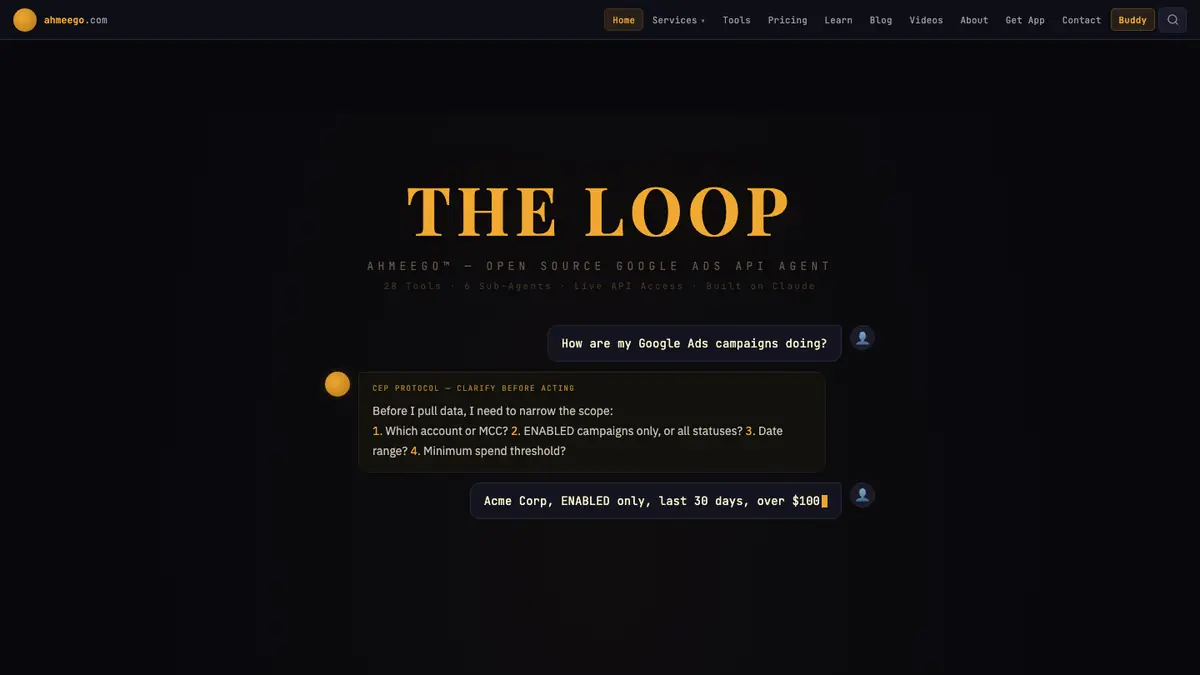
ahmeego.com, our free AI tools for advertisers
ahmeego.com: free tools we built for advertisers · See our work
The short answer

AI search optimization, also called generative engine optimization (GEO) or answer engine optimization (AEO), improves the chances that AI systems like Google AI Overviews, AI Mode, ChatGPT, Gemini, Copilot and Perplexity cite and recommend your business. It builds on SEO fundamentals and adds answer-first content structure, clear entity information, comprehensive coverage of the follow-up questions AI systems explore, structured data, and allowing the right crawlers.

Who this is for

Is ai search optimization right for you?

  • Businesses whose customers research in ChatGPT, Perplexity or Gemini before buying
  • B2B and professional services firms where recommendations drive deals
  • Brands that rank well in Google but rarely appear in AI answers
  • Publishers and experts who want their expertise attributed
What's included

What you get with our ai search optimization.

  • AI visibility baseline across priority questions in major assistants
  • Crawler access review (Googlebot, Bingbot, OAI-SearchBot, PerplexityBot and others)
  • Entity audit: consistent business information, founder and author signals, sameAs links
  • Answer-first rewrites of key pages: short summaries, clear headings, direct answers
  • Question research covering the sub-questions AI systems explore
  • FAQ content grounded in real customer questions
  • Structured data for Organization, Person, Service, Product, Article and FAQ
  • llms.txt and machine-readable summaries where useful
  • Citation-worthy assets: original data, guides, definitions
  • Monthly tracking of citations and brand mentions in AI answers
How the engagement works

From first call to compounding results.

Weeks 1–2

Baseline

Test priority questions across assistants and record which sources are cited, including competitors.

Weeks 2–4

Foundation

Fix crawler access, entity consistency, structured data and technical blockers.

Months 1–3

Content

Restructure key pages answer-first, fill coverage gaps, and publish citation-worthy assets.

Ongoing

Track

Monitor citations and mentions monthly and expand into new question clusters.

How AI search chooses sources

What we know, and what we don't.

AI search systems generally retrieve web pages relevant to a question, often running several related searches behind the scenes to cover sub-topics, then synthesize an answer and cite some of the sources. Google describes this "query fan-out" technique for AI Overviews and AI Mode.

The practical implications:

  • Classic SEO still matters. Google says the same SEO best practices apply to AI features, and pages need to be indexed and eligible to show a snippet to be used.
  • Coverage matters. Because systems explore follow-up questions, pages that comprehensively cover a topic and its sub-questions have more chances to be retrieved.
  • Extractability matters. Clear headings, direct answers near the top, definitions, lists and tables are easier to quote accurately.
  • Entity clarity matters. Consistent business information, real authors with credentials, and corroborating mentions on reputable sites help AI systems trust who you are.

What nobody can honestly promise: guaranteed citations. AI answers vary by phrasing, user and time. We measure across many questions and track trends rather than single answers.

What we change on your site

Practical, not mystical.

  • A short answer at the top of key pages: two to four sentences that directly answer the main question. You'll see one at the top of this page.
  • Question-shaped headings that match how people ask, with the answer immediately beneath.
  • Real FAQs sourced from sales calls, support tickets, Search Console queries and People Also Ask, not invented filler.
  • Specifics: numbers, timelines, prices or price factors, named tools, and links to primary sources. Vague content rarely gets cited.
  • Author and business transparency: who wrote it, their experience, when it was last reviewed, and how to contact you.
  • Crawler access: making sure search and AI crawlers you want aren't blocked by robots.txt, firewall or bot-management rules. This is a surprisingly common problem on Cloudflare-protected sites.

Read our perspective in Truths in AI: search has a citation problem.

What we usually find

The problems we fix most often.

AI crawlers blocked by the firewall

Bot protection silently blocking search and AI crawlers you actually want.

Answers buried in paragraph five

Key facts hidden under long introductions that AI systems skip.

Inconsistent entity information

Different business names, addresses or founder details across the web.

No author or date

Anonymous, undated content that's hard to trust and easy to skip.

Pricing

How pricing works.

Included in our SEO + GEO retainers, or available as a standalone project: baseline, foundation fixes and restructuring of priority pages, quoted after a free AI visibility check.

Arizona + nationwide

Local team, national reach.

We are based at 35094 N Jacobs Rd in Queen Creek and work with businesses across the Phoenix metro, Tucson and Northern Arizona in person, and with clients across the United States remotely. Same senior team, same process, wherever you are.

In practice

How AI search engines actually pick their sources.

I'd rather show you what Google, OpenAI and Perplexity say in their own documentation than sell you a secret formula.

How does Google choose which sites appear in AI Overviews and AI Mode?

Google picks supporting links for AI Overviews and AI Mode from its regular search index using its core ranking systems, so a page has to be indexed and eligible to show a snippet before it can be cited.

Google's documentation names two techniques. The first is retrieval-augmented generation, also called grounding: the system pulls relevant pages from the index and builds the answer from them, with links. The second is query fan-out: the model runs several related searches at the same time to cover sub-topics. Google's own example turns a question about a lawn full of weeds into searches about herbicides, removing weeds without chemicals and preventing them.

That second point matters most. You can be cited for a broad question because you have the clearest answer to one narrow sub-question inside it. Google also says there are no extra technical requirements and no special markup needed for AI features.

So we map the sub-questions around your main topics, the same way this section was built, and make sure each one has a direct answer on a page Google already indexes.

Sources: AI features and your website (Google Search Central), Google's guide to optimizing for generative AI features on Google Search (Google Search Central)

How does ChatGPT decide which websites to cite?

ChatGPT search rewrites the user's question into one or more search queries, sends them to third-party search providers, and cites pages from those results that answer the question.

OpenAI's help center describes the flow. A detailed question becomes a targeted query, and after reading the first results, ChatGPT may send more specific follow-up queries. It can also use general location to localize searches. OpenAI does not publish how it ranks what comes back.

The part you control is access. OpenAI's search crawler is OAI-SearchBot, and sites that block it in robots.txt will not appear in ChatGPT search answers beyond bare navigational links. GPTBot is a separate crawler for model training, so you can block training and still allow search. Check your firewall or CDN too, because bot protection can block these crawlers even when robots.txt allows them.

ChatGPT adds utm_source=chatgpt.com to referral links, so you can see that traffic in GA4. In my experience, the sites that get cited answer specific questions plainly and are talked about elsewhere.

Sources: Searching the web with ChatGPT (OpenAI Help Center), Overview of OpenAI crawlers (OpenAI), Publishers and developers FAQ (OpenAI Help Center), Advertiser guidance for allowing OpenAI web crawlers (OpenAI Help Center)

How does Perplexity choose its sources?

Perplexity answers by searching the web, drawing on its own index built by PerplexityBot and on pages it fetches live while answering, then shows numbered citations next to its claims.

Its documentation separates the two. PerplexityBot crawls and indexes pages so they can be surfaced and linked in results, respects robots.txt and is not used to train models. Perplexity-User visits a page when someone asks a question, and because a person triggered the visit, Perplexity says it generally ignores robots.txt. If you block PerplexityBot, your full text stays out of its index, though it may still keep your domain, headline and a brief factual summary.

Perplexity also labels some cited domains as Government, Academic or Trusted. Its review asks plain questions: does the site correct its mistakes, does it say who wrote each piece, does it keep news separate from advertising and opinion. Most sites carry no label, and Perplexity says that is not a negative judgment.

Those questions make a good checklist for any business site. Put a named author on content, show when it was updated, and correct errors in public.

Sources: Perplexity crawlers (Perplexity docs), How does Perplexity follow robots.txt? (Perplexity Help Center), Understanding source labels (Perplexity Help Center)

Do I need to rank on page one of Google to show up in AI answers?

Not for the exact question asked, but your page does need to rank well for something closely related, because Google's AI features are built on its core ranking systems.

Query fan-out is the reason. When AI Mode splits a question into several sub-searches, the pages it cites are the ones that do well on those sub-searches. A page stuck on page two for a broad head term can still be cited if it is the clearest answer to one specific follow-up. Google says these features show a wider and more diverse set of links than a classic results page.

ChatGPT and Perplexity work from their own crawlers and search partners, so your Google rank does not carry over directly. What carries over is being crawlable, being indexed and having pages that answer specific questions in plain words.

A quick check you can do today: take one service page and list the five follow-up questions a buyer asks before calling you. If the page answers none of them directly, that is the gap. Our SEO + GEO work fills it page by page.

Sources: Google's guide to optimizing for generative AI features on Google Search (Google Search Central), AI features and your website (Google Search Central)

Why does ChatGPT or Gemini get facts about my business wrong?

Usually because the information about your business on the web is thin, outdated or inconsistent, and the assistant fills the gap with whatever sources it finds.

AI assistants summarize what they retrieve; they do not check with you first. If an old directory lists a previous address, a review site shows outdated hours and your own About page never says who runs the company, the model blends those signals. OpenAI's own help center warns that search results and citations can be incomplete, outdated or incorrect.

The fix is unglamorous. Make one page on your site the clear source of truth for who you are, what you offer, where you work and who runs it, with Organization structured data that matches. Clean up old listings so they agree. Then earn mentions where people actually talk: industry sites, local press, Reddit, Quora and YouTube. I post on those channels myself because assistants read them.

Retest the same prompts every month. Corrections take time to show up, and they rarely come from your own site alone.

Sources: Searching the web with ChatGPT (OpenAI Help Center), Organization structured data (Google Search Central)

Can I opt out of Google AI Overviews without hurting my rankings?

Yes. Search Console now has a Search generative AI control that removes your site from AI Overviews, AI Mode and generative features in Discover, and Google says the setting is not used as a ranking signal for the rest of Search.

Google rolled the control out to all sites on August 31, 2026, under Settings in Search Console. Inclusion is the default. If you exclude your site, your links and content will not appear in those features or be used to ground AI answers, so you also get no impressions or clicks from them. Google notes that similar content from other sites can still show.

For most businesses I would not opt out. Buyers ask these questions in AI Mode whether you are there or not, and being absent hands the citation to a competitor. The exceptions are publishers whose content is the product, or pages where a summary would give away what you sell.

Before deciding, open the Generative AI performance report in Search Console and see what those features send you today.

Sources: Search generative AI control (Search Console Help)

Do Reddit, Quora and YouTube matter for AI search?

Yes. AI assistants pull from many sources beyond your website, and community sites like Reddit and Quora, plus YouTube, appear in AI answers often because they hold real people answering real questions.

That is the shift from classic SEO. Google ranks pages; assistants summarize answers. If your expertise lives only on your own site, you are one voice. If the same expertise shows up in a helpful Reddit thread, a Quora answer and a how-to video, the assistant sees agreement across sources, and agreement is what it trusts. Google even describes its fan-out searches as running across subtopics and data sources.

My rule is to post as a person, not a brand. Give step-by-step answers with real examples, say who you are, and link back only when it truly helps. The one-line replies you see in many subreddits, like telling someone to raise their budget, teach nobody and get cited by nobody.

This does not replace SEO. It is the next layer on top. Related reading: AI search has a citation problem.

Sources: AI features and your website (Google Search Central)
FAQ

AI Search Optimization: questions we get asked.

What is AI search optimization?

The practice of improving how often and how accurately AI systems like Google AI Overviews, ChatGPT, Gemini, Copilot and Perplexity cite and recommend your business. It's also called GEO (generative engine optimization) or AEO (answer engine optimization).

Is GEO different from SEO?

It builds on SEO rather than replacing it. Google says standard SEO best practices apply to its AI features. GEO adds emphasis on answer-first structure, comprehensive coverage of related questions, entity clarity and citation-worthy specifics.

How do I get my business mentioned by ChatGPT?

ChatGPT's search features retrieve current web content, so the basics apply: be indexed and crawlable (including by OpenAI's search crawler), publish clear, specific, authoritative answers, and be mentioned consistently on reputable third-party sites.

Should I block AI crawlers?

It depends on your goals. Blocking training crawlers is a business decision. Blocking search crawlers, such as OAI-SearchBot, PerplexityBot or Googlebot, can remove you from AI answers entirely. We help you allow the ones that drive visibility and block the ones you don't want.

What is llms.txt?

A proposed standard file that gives language models a concise, curated summary of your site and its key pages. Adoption by AI providers is uneven, but it's low-cost to add and we include it where it makes sense.

Does structured data help with AI search?

Structured data helps search engines understand entities and page types, which supports eligibility for rich results and clearer entity understanding. It isn't a guaranteed path to AI citations, but it's part of a strong foundation.

How do you measure AI search visibility?

We test a defined set of priority questions across assistants each month and record whether you're mentioned or cited, alongside competitors, plus referral traffic from AI platforms in GA4.

How long does AI search optimization take?

Foundation fixes take weeks. Citation gains depend on how often AI systems refresh their retrieval and how competitive the topic is. Expect to see trends over two to four months.

Will AI Overviews reduce my website traffic?

For some informational queries, yes. Clicks can shift as answers appear on the results page. Being cited in the overview is the best defense, and it builds brand recognition with people who are ready to buy.

Can you guarantee my business will be recommended by AI?

No. AI answers vary by phrasing, user and time, and no one controls them. We improve the factors that make citation more likely and report trends honestly.

Learn from the source

The official documentation we work from.

We build to the platforms' own published guidance. These are the primary sources behind this page.

John M. Williams
Written and reviewed by John M. Williams, founder. 15+ years in paid media, $350M+ managed spend, Hero Conf 2025 and 2026 speaker. Last reviewed .
Get started · AI Search Optimization

Tell us about your business.

Quick form, no obligation. John personally reviews every submission and replies within 24–48 hours with an honest read on whether ai search optimization is the right next move.

  • → Honest assessment of where you are
  • → Buddy-powered audit (if you're already running ads)
  • → Top 10 prioritized fixes (effort × impact)
  • → 30/60/90-day roadmap + scope of work

Prefer to talk first? (602) 563-6976 · hello@itallstartedwithaidea.com

By submitting you agree to a one-time review of what you share. NDAs available on request. Privacy.