It All Started With An Idea
Service · Paid Search

Paid Search done with the same agent we built.

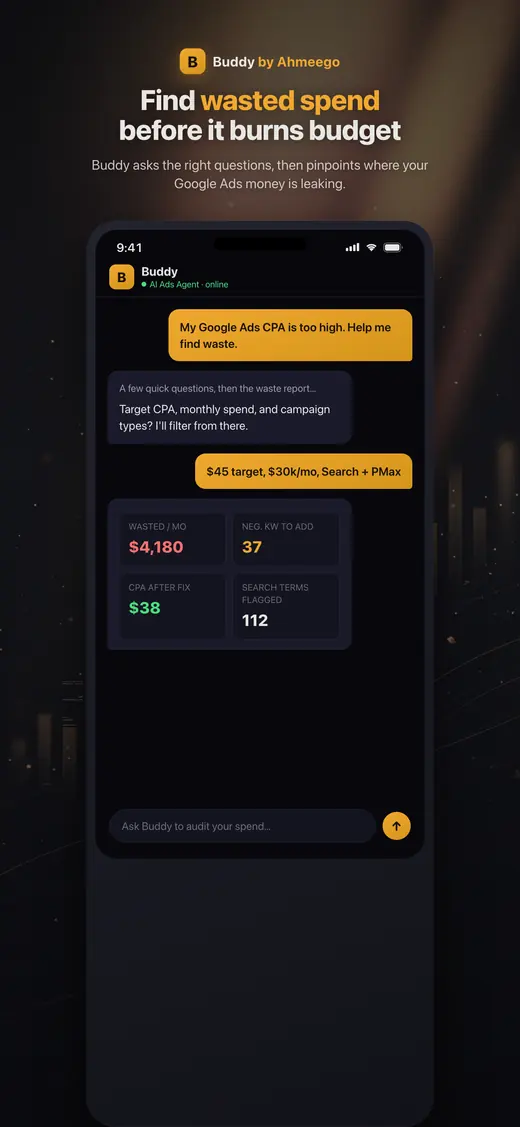
Google Ads + Microsoft Ads + Performance Max + Shopping. Every account managed using Buddy, our open-source AI agent. Live API access. Asks before acting. Labels for rollback.

Buddy app finding wasted Google Ads spend
Buddy, our AI agent, on iOS and Android · See our work
Why paid search management matters

What separates a good paid search management engagement from a bad one.

Four things we get right on every paid search management account.

01

Live API access via Buddy

Most agencies log into your Ads UI and click around. Our entire workflow runs through the Google Ads API via Buddy — faster, fewer mistakes, every change labeled.

02

Performance Max done properly

PMax is a black box if you let it be. We feed it the right asset groups, audience signals, geo + device modifiers — and we know what to look for in the placement reports.

03

Shopping + Merchant Center health

Half of Shopping problems are feed problems. We audit the feed monthly, fix disapprovals, validate GTIN, and route GMC issues before they impact spend.

04

Honest measurement

GA4 + Tag Manager + server-side via Cloudflare Zaraz. Conversion data you can actually trust — including enhanced conversions for iOS/privacy-impacted attribution.

What we run

Capabilities for paid search management.

Every paid search management engagement covers the full surface area below — not a stripped-down trial offering.

  • Google Ads (Search, Performance Max, Shopping, App, Discovery, Demand Gen)
  • Microsoft Advertising (Bing) — full feature parity with Google Ads
  • Keyword research + ongoing search-term mining via Buddy
  • Bid-strategy selection + automated bidding tuning
  • Conversion tracking — GA4, GTM, server-side via Cloudflare Zaraz
  • Performance Max asset groups with creative QA
  • Shopping feed health + GMC diagnostics + GTIN validation
  • Negative-keyword automation via Buddy (with rollback labels)
  • Quality Score forensics + landing-page intent matching
  • Weekly + monthly reporting + an honest scorecard
  • Enhanced conversions + offline conversion uploads
  • Cross-network bid coordination (Google + Microsoft)
The Loop · how we work

The Loop in action.

The same operating principle Buddy uses on every client account — applied to your engagement.

01

Clarify before acting

We narrow scope before any data pull. Which accounts, which date range, which KPIs matter most. No assumptions.

02

Top-down analysis

Account-level summary first. We don't lead with data dumps — we lead with what the numbers actually mean for your business.

03

Preview before execute

Every meaningful change gets a confirmation step with projected impact. You approve the move. Then Buddy executes.

04

Label for rollback

Every change is timestamped + labeled. One-click undo. Full change history that survives team turnover.

Track record

By the numbers.

$350M+
Managed ad spend
15+ yrs
On Google Ads
28
Buddy API actions
6
Specialized sub-agents
How we approach Google Ads

Performance Max is not autopilot.

The pitch on Performance Max is "Google figures it out." That's marketing — and partially true. PMax does extract more from your existing intent than manual search campaigns ever did. But it also wastes budget on bad placements, mismatches audiences, and reports back in a way that hides the failure modes if you let it.

What we actually do on PMax:

  • Asset group architecture — segmented by audience signal, not by product. One asset group per intent cluster.
  • Audience signal tuning — Customer Match + Combined Audiences + targeted In-Market signals to give the algorithm a starting point that's actually relevant.
  • Placement filtering — Account-level exclusions for low-quality YouTube channels, mobile-app burning, and the geographic patterns the algorithm picks up on noise.
  • Negative-keyword overrides — Google quietly added these — we use them aggressively.
  • Bid-strategy iteration — Maximize Conversion Value → tROAS → manual blends, in that order, as the account matures.

Shopping + Merchant Center hygiene

If you sell physical products, half the lift in your account is in the feed — not the campaigns. We audit GMC monthly, validate GTIN, fix disapprovals at the SKU level, and route image quality issues to your team before Google penalizes you.

Microsoft Advertising

Microsoft Ads (Bing) reaches a different — and often more affluent — audience for a fraction of Google's CPC. We run Microsoft as a peer to Google, not as an afterthought, with full feature parity (Performance Max equivalents, Shopping, audience ads).

Measurement

Numbers you can trust.

We're tired of "marketing said we hit our ROAS" while finance can't tie it back to revenue. Every account we manage gets a measurement layer worth trusting:

  • GA4 implementation review (events, custom dimensions, identity stitching)
  • Google Tag Manager hygiene — duplicate event firing, race conditions, container size
  • Server-side tagging via Cloudflare Zaraz or GTM Server (your call)
  • Enhanced Conversions for Web + Leads where applicable
  • Offline conversion uploads back into Google Ads from your CRM
  • Cross-channel attribution using GA4 + first-party data, not third-party cookies

If we look at your account and the measurement is broken, we say so before we propose a media plan. Fixing measurement is usually a 30-day project — and it's almost always the highest-leverage thing we'll do for you.

A client said it best

What working with us actually feels like.

“It does not have to be great, good, or even unique. It just has to start as an idea. No idea is a bad idea — advertising can be anyone's Disneyland.”
John M. Williams · Founder
In practice

What people ask about paid search on Google and Microsoft.

These are the search-specific questions we get once people know what paid search is and want to know how it behaves now.

Should I invest in paid search or SEO first?

Start with paid search when you need leads this month and can measure them; start with SEO when you can wait and your buyers research before they buy. Most businesses end up needing both, but paid search tells you faster which keywords actually turn into customers.

That is the underrated part. A few weeks of search ads give you real conversion data by query, which tells your SEO plan which pages to build first. It works the other way too: strong organic pages make better landing pages, and landing page experience is part of how ads are ranked.

Organic listings, AI summaries and ads now share the same results page, so separate budgets with separate owners leave gaps. I wrote about that in paid and organic are indistinguishable. A simple test: pull your top converting paid search terms and check where you rank organically for each one. Terms where you pay heavily and rank nowhere are your SEO priority list.

Sources: How the Google Ads auction works (Google Ads Help)

How does the paid search auction decide who shows and what I pay?

Every search triggers an auction where Google weighs your bid, the quality of your ad and landing page, the expected impact of your assets and the context of the search. You often pay less than your maximum bid, and a more relevant ad can beat a higher one.

Google's documentation lists six factors: your bid, ad quality, Ad Rank thresholds, how competitive the auction is, the context of the search such as location, device and time, and the expected impact of assets like sitelinks and call buttons. Microsoft Advertising runs a similar auction, usually with fewer advertisers bidding.

In practice, you cannot buy your way past a weak landing page forever. We treat Quality Score components as a diagnostic, not a goal. If expected click-through rate is low, the ad does not match the query. If landing page experience is low, the page does not answer it. One useful detail: when several of your own keywords match the same search, they do not bid against each other. Our landing page work starts from that diagnosis.

Sources: How the Google Ads auction works (Google Ads Help)

Do search ads still work with AI Overviews on Google?

Yes. Ads can show above, below and inside AI Overviews, and commercial searches still send ad clicks. What changes is which keywords and match types can reach those placements.

Per Google, ads from existing Search, Shopping and Performance Max campaigns are eligible above or below AI Overviews, and in the US they can also appear inside the overview when both the query and the overview content fit your offer. Google's Ads Liaison has said only broad match or keywordless targeting can trigger ads inside an AI Overview; exact and phrase match cannot. Sensitive categories such as finance and healthcare are currently excluded from in-overview ads.

So the real question for your account is how much broad match and AI Max you are willing to run, and whether your conversion data is clean enough to steer them. High-intent searches, like a service plus a city, behave much as they always have. On any broad or AI Max campaign we read search terms every week. For the organic side of AI answers, see AI search optimization.

Sources: About ads and AI Overviews (Google Ads Help), Google: Exact match keywords won't block broad match in AI Max (Search Engine Land, quoting Google's Ads Liaison)

What is AI Max for Search, and should I turn it on?

AI Max for Search is a Google Ads feature that couples broader query matching, generated ad text and landing page selection with Smart Bidding in one loop. Turn it on only after tracking, conversion volume and negative keywords are solid.

Google turns it on by default for new Search campaigns, says its matching and URL features need conversion-based Smart Bidding, and notes it will not be effective on a campaign limited by budget. Each piece helps alone. Together they pick the query, the message and the page, so a weak result could come from any of the three, and a blended CPA can look fine while spend leaks to terms that never convert. I take lift claims with some skepticism until I see them in a specific account.

When we run it, we check three things weekly: search terms, to add negatives and protect brand; landing paths, because expanded URLs can send a high-intent click to a generic page; and generated copy, which can test claims you never approved. If wasted spend climbs, pause expansion before adding budget. See our take on broad match.

Sources: Set up AI Max for Search campaigns (Google Ads Help), How AI Max for Search campaigns works (Google Ads Help)

Should I bid on my own brand name in paid search?

Usually yes, especially when competitors bid on your name, when you want control of the message, or when your organic listing does not consistently capture those searches. Skipping it only makes sense when you own the page, nobody else bids and budget is tight.

Brand clicks are typically cheap and convert well, which is exactly why they need their own campaign. Mixed into non-brand, they make the account look healthier than it is and hide how expensive new-customer acquisition really is. Performance Max and AI Max will also absorb brand searches unless you set brand exclusions, which Google now offers for both.

To decide, test it. Pause brand ads for a few weeks in one region or during set hours, then compare total brand conversions, paid plus organic, against the period before. If the total holds, you were mostly paying for clicks you would have gotten anyway. If it drops or a competitor takes the top spot, turn brand back on. Run the same check on Microsoft Ads separately. See Performance Max for how we handle brand there.

Sources: Apply brand exclusions to Performance Max or Search campaigns (Google Ads Help)

Which paid search metrics matter most?

Watch cost per acquisition or return on ad spend against your target, spend on search terms with zero conversions, and whether lost impression share comes from budget or from rank. Clicks and click-through rate are diagnostics, not goals.

Decide the success metric before touching bids. A lead gen campaign judged on ROAS will starve volume, and a brand campaign judged on CPA will underbid the terms that protect your name. Then check zero-conversion spend. In the accounts I audit, a real share of monthly spend usually sits on search terms that never convert, and cheaper clicks only scale that leak.

Impression share tells you which lever to pull. Google reports share lost to budget and share lost to rank separately. If you lose share to budget while the searches you win convert well, add budget before raising bids, since higher bids on a capped campaign burn the same money faster. If budget is fine but you lose to rank on the terms that convert, raise bids or improve ads there only. More in our top PPC questions.

Sources: About impression share (Google Ads Help)
FAQ

Common questions about paid search management.

How is this different from other Google Ads agencies?

We use Buddy on every client account. Buddy is an open-source AI agent we built — it has live Google Ads API read/write access, asks clarifying questions before every action, and labels every change for one-click rollback. The result is faster decisions, fewer mistakes, and a complete audit trail. Most agencies are still doing all of this manually.

Do you require a long-term contract?

No. We run month-to-month. Every engagement starts with a free audit so you know exactly what you're getting before any contract.

What does it cost?

We use a flat monthly retainer plus a small percentage of ad spend, scaled to account size. Quote follows your free audit.

Can you take over an existing Google Ads account, or do you have to start fresh?

We almost always start by working inside your existing account. We label every change Buddy makes so you can see exactly what changed and roll back if needed.

How fast will we see results?

Buddy's audit can flag wasted spend within 24 hours. Structural changes (negative keywords, bid strategy, conversion fixes) typically show in 7-14 days. Strategy-level improvements (PMax, Shopping feed, new campaign types) take 30-60 days to mature.

More questions

More about paid search (google + microsoft).

What is paid search?

Paid search is advertising on search engines like Google and Bing where you bid on keywords and pay when someone clicks your ad. It reaches people at the moment they're searching for what you sell.

Should I advertise on both Google and Microsoft?

Usually yes. Google has the most volume, while Microsoft Ads reaches Bing, Yahoo, AOL and DuckDuckGo users, often at a lower cost per click, with LinkedIn profile targeting for B2B. See Microsoft Ads management.

What's the minimum engagement?

A $2,000 monthly management fee plus at least $3,000 a month in ad spend. Below that, ad data is too sparse for meaningful optimization.

Do you manage Shopping and Performance Max?

Yes. Shopping and PMax are part of paid search management, including Merchant Center feed health. See Performance Max and Merchant Center.

How do you choose keywords?

From your services and margins, search volume and intent, competitor research, and search-term data from your account. Buddy mines search terms weekly for new keywords and negatives.

Can I see what you change in my account?

Yes. Every change is labeled with a date and reason, and you keep full access to your account at all times.

Do you offer a free audit?

Yes, for accounts spending $3,000 or more a month. See our Google Ads audit.

Learn from the source

The official documentation we work from.

John M. Williams
Written and reviewed by John M. Williams, founder. 15+ years in paid media, $350M+ managed spend, Hero Conf 2025 and 2026 speaker. Last reviewed .
Get started · Paid Search Management

Tell us about your business.

Quick form, no obligation. We'll come back within 24-48 hours with an honest read on whether paid search management is the right next move and what a paid search management engagement with us looks like.

  • → Honest assessment of where you are
  • → Buddy-powered audit (if you're already running ads)
  • → Top 10 prioritized fixes (effort × impact)
  • → 30/60/90-day roadmap + scope of work

Prefer to talk first? (602) 563-6976 · hello@itallstartedwithaidea.com

By submitting you agree to a one-time review of what you share. NDAs available on request. Privacy.