It All Started With An Idea
Commerce · Amazon

Amazon growth measured in profit, not just sales.

We manage Amazon advertising and listings together, because ads can't fix a listing that doesn't convert and a great listing doesn't sell without visibility. Every decision is measured against margin.

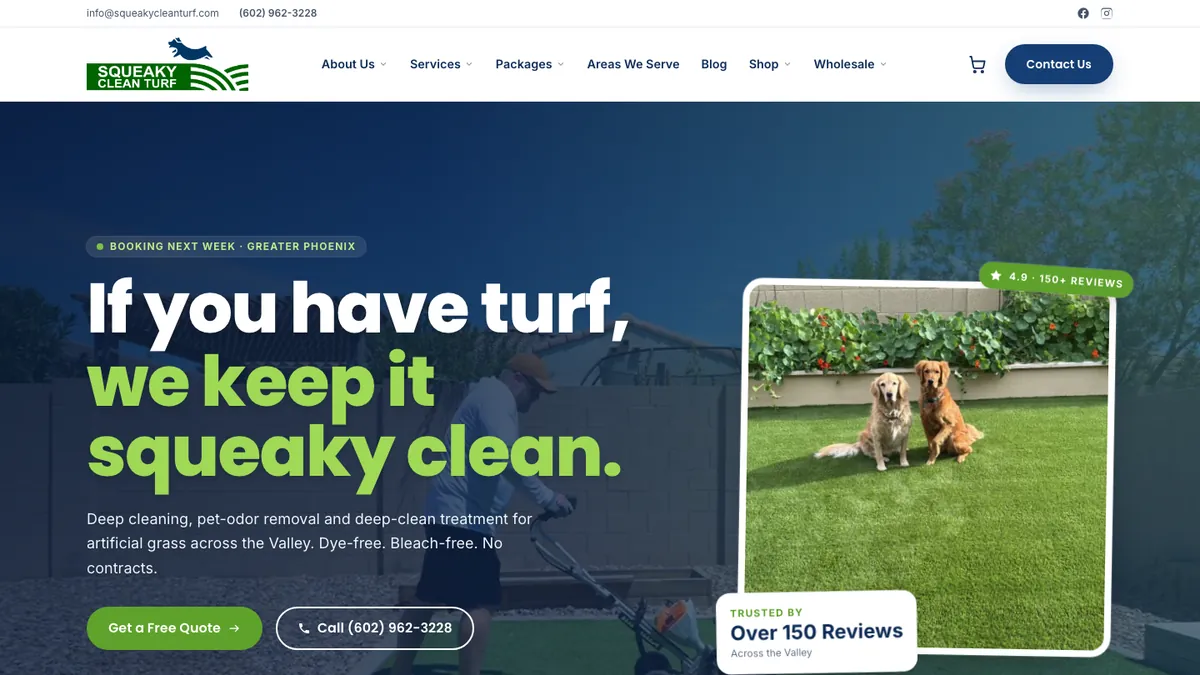
Squeaky Clean Turf website
Squeaky Clean Turf: website, headless shopify · See our work
The short answer

Amazon marketing covers advertising (Sponsored Products, Sponsored Brands, Sponsored Display and Amazon DSP) and the listing quality that determines whether ad traffic converts: titles, bullets, images, A+ content, reviews, pricing and the Brand Store. We manage both, optimizing toward profitability metrics like TACoS (ad spend as a share of total sales) rather than ad-attributed sales alone.

Who this is for

Is amazon marketing right for you?

  • Brands selling on Amazon through Seller Central or Vendor Central
  • Brands whose Amazon ad spend is rising faster than total sales
  • DTC brands expanding to Amazon for the first time
  • Brands needing Brand Registry, A+ content and brand protection
What's included

What you get with our amazon marketing.

  • Account and advertising audit
  • Sponsored Products, Sponsored Brands and Sponsored Display management
  • Keyword harvesting from search term reports and negative keyword management
  • Listing optimization: titles, bullets, descriptions, backend search terms
  • Image and A+ content briefs
  • Brand Registry setup and Brand Store design
  • Amazon DSP strategy for larger brands
  • Pricing and Buy Box monitoring
  • Inventory planning input to avoid stockouts
  • Profit-focused reporting: ACoS, TACoS, organic rank, contribution margin
How the engagement works

From first call to compounding results.

Week 1

Audit

Review listings, ads, search terms, inventory health and profitability by product.

Weeks 1–4

Fix listings

Improve titles, bullets, images and A+ content on top products first.

Weeks 2–4

Restructure ads

Separate discovery from proven keywords, set bids by margin, and add negatives.

Ongoing

Grow

Scale profitable keywords, defend brand terms, and expand catalog and DSP.

Ads and listings together

Traffic, conversion, profit.

On Amazon, advertising and organic ranking feed each other. Ads drive sales, sales velocity supports organic rank, and organic rank brings sales without ad cost. But that only works if the listing converts.

That's why we look at TACoS, total ad spend divided by total sales, alongside ACoS. A falling TACoS means ads are building organic momentum. A rising TACoS means you're buying sales you'd otherwise lose, which isn't sustainable.

Campaign structure

Discover, prove, scale.

  • Discovery campaigns with automatic and broad targeting find new converting search terms.
  • Performance campaigns with exact match and product targeting scale the terms that are proven to be profitable.
  • Brand defense with Sponsored Brands and Sponsored Display on your own brand terms and product pages.
  • Negatives flow between them so proven terms stop being bid on twice and losing terms stop spending.

Bids are set from each product's margin, not a blanket ACoS target. See our related thinking in the Amazon advertising audit guide.

What we usually find

The problems we fix most often.

One ACoS target for everything

The same target across products with very different margins.

Auto campaigns never harvested

Converting search terms left in auto campaigns instead of scaled in exact match.

Listings written for keywords, not people

Keyword-stuffed titles and bullets that rank but don't convert.

Pricing

How pricing works.

Monthly management fee scaled to ad spend, catalog size and listing work, quoted after a free account audit. Ad spend is billed by Amazon directly.

Arizona + nationwide

Local team, national reach.

We are based at 35094 N Jacobs Rd in Queen Creek and work with businesses across the Phoenix metro, Tucson and Northern Arizona in person, and with clients across the United States remotely. Same senior team, same process, wherever you are.

In practice

What people ask before hiring an Amazon agency.

Amazon questions almost always come back to margin, so that's where we answer them from.

How much does an Amazon advertising agency cost?

Our Amazon management is a flat monthly retainer plus a small percentage of ad spend, and most engagements land between $2,000 and $15,000 a month depending on spend, catalog size and how much listing work is involved.

The minimum is $2,000 a month in management with at least $3,000 a month in ad spend. Ad spend itself is billed by Amazon directly, not marked up by us. Engagements are month to month with 30-day cancellation.

Whoever you hire, ask how the fee changes if your ad spend doubles. A fee that's purely a percentage of spend pays the agency more for spending more, whether or not your profit grows. That's why we keep the percentage small and anchor the work to TACoS and contribution margin rather than ad-attributed sales.

Also ask what's outside the fee. Listing rewrites, A+ content briefs, Brand Store design and DSP are often billed separately. Our free audit comes back within 48 hours, and it's a good way to see how we think before you commit. Our Amazon audit guide shows what we look at.

What is a good ACoS on Amazon?

A good ACoS is one below your break-even ACoS, which equals your profit margin before advertising; there's no universal number that's good for every product.

Work it out per product. Say a product sells for $40, and after cost of goods, Amazon fees, shipping and returns you keep $14 before ads. Your break-even ACoS is $14 divided by $40, or 35%. At 35% you make nothing on ad-driven sales. Below it you profit. A product with a $6 margin on the same price breaks even at 15%, so the same ACoS can be healthy on one item and a loss on another.

Then decide what each product is for. I make the same call on Google Ads when choosing between a ROAS target and a CPA target: profit now, or customers and growth now. On Amazon, a launch product can run above break-even on purpose to build sales velocity and rank, but only with a budget and an end date.

Read more on how we set targets in our bidding strategy work.

Sources: What is advertising cost of sales (ACOS)? (Amazon Ads)

How much should I spend on Amazon ads?

Spend enough to give discovery campaigns real data on your priority products, then grow budget only on the keywords and targets that are profitable against each product's break-even ACoS.

Budget by product, not by account. A hero product with strong reviews and healthy margin deserves most of the money. A new item with five reviews will waste spend no matter how good the bids are, so fix the listing first.

Discovery costs money up front. Automatic and broad campaigns will spend on terms that don't convert while they find the ones that do. Set that as a fixed test budget, harvest the winners into exact match, add negatives, and judge it after enough clicks to mean something rather than after a few days.

The signal to raise budget is simple: profitable exact-match campaigns running out of budget before the day ends. The signal to slow down is TACoS rising while total sales stay flat. For a managed engagement with us, the floor is $3,000 a month in ad spend, because below that there usually isn't enough data to optimize.

How do Amazon ads work with Rufus and AI shopping?

Amazon now runs AI-generated Sponsored Products and Sponsored Brands prompts inside your existing campaigns, shown in search results and on product pages, and when clicked they can open a conversation in Rufus or answer the shopper on the page.

Amazon made prompts generally available in the U.S. in March 2026. Eligible campaigns are enrolled automatically, use your existing targeting, and are charged through your normal cost-per-click billing. You can review each prompt that got a click, with impressions, clicks and orders, under the ad group's Prompts tab, and pause any that miss the mark.

The important part is where the answers come from. Amazon says prompts draw on your detail page, Brand Store and campaign data. So a listing that clearly answers real shopper questions, such as fit, compatibility, materials and use cases, gives the AI better material than one stuffed with keywords. I've made the same point about LLMs generally: they summarize, so write for questions, not just search terms.

Check the Prompts tab monthly and feed recurring themes back into your bullets and A+ content. More in our AI search work.

Sources: Sponsored Products prompts and Sponsored Brands prompts (Amazon Ads)

Why are my Amazon ads getting clicks but no sales?

Clicks without sales usually mean either the traffic is wrong or the listing doesn't convert, and the search term report tells you which one.

Open the search term report for the campaign. If the spend is on terms that don't describe your product, it's a targeting problem: add negatives, tighten match types and pull back on broad automatic targeting. If the terms are relevant and still don't convert, the problem is on the product page.

Listing problems are usually visible from the shopper's side. Compare your price, star rating, review count and main image with the products ranked around you for that search. Check whether you hold the Buy Box and whether popular sizes or colors are out of stock, because ads can keep sending traffic to a variant nobody can buy. Then compare your unit session percentage in Business Reports with your other products to see which listings underperform.

Ads can't fix a listing that loses side by side. That's why we fix titles, images and A+ content on top products before scaling spend. Our audit guide walks through the checks.

Should I manage my Amazon ads myself or hire an agency?

Manage them yourself if your catalog is small, your spend is modest and you'll block out time every week; hire help when spend, SKU count or the overlap between listings, inventory and ads outgrows the hours you have.

A workable DIY routine looks like this. Weekly, pull search term reports, move converting terms from auto and broad campaigns into exact match, add negatives for terms that spend without selling, and adjust bids against each product's break-even ACoS. Monthly, check TACoS by product, review listings on your top sellers, and confirm nothing important is close to stocking out.

Where owners struggle isn't the steps. It's consistency, and the connections between them. A stockout tanks rank, ads keep spending on the dead variant, and nobody notices for two weeks.

If you're below our minimum of $2,000 a month in management and $3,000 a month in ad spend, I'd honestly rather you run the routine above yourself, and we'll say so on the free audit. If you sell on both Amazon and your own store, see how we connect them in commerce and systems.
FAQ

Amazon Marketing: questions we get asked.

What's the difference between ACoS and TACoS?

ACoS is ad spend divided by ad-attributed sales. TACoS is ad spend divided by total sales, including organic. TACoS shows whether advertising is building sustainable growth.

What are Sponsored Products, Sponsored Brands and Sponsored Display?

Sponsored Products promote individual listings in search and on product pages. Sponsored Brands feature your logo, headline and multiple products or video. Sponsored Display reaches shoppers on and off Amazon based on products viewed and audiences.

Do I need Brand Registry?

If you own a trademark, yes. Brand Registry unlocks A+ content, Sponsored Brands, Brand Stores, brand analytics and stronger protection against counterfeits and hijackers.

How long before Amazon ads become profitable?

Discovery campaigns are often unprofitable at first while they collect data. Most accounts reach steady profitability within two to three months as converting terms are scaled and losing ones cut.

Can you optimize my Amazon listings?

Yes. We rewrite titles, bullets, descriptions and backend search terms, and brief images and A+ content, prioritizing products with the most revenue potential.

What is Amazon DSP?

Amazon's demand-side platform for programmatic display and video ads using Amazon shopper data, on and off Amazon. It's best suited to larger brands with established Sponsored Ads programs.

Do you work with Vendor Central?

Yes, although most of our clients use Seller Central. The advertising principles are the same, while operations and reporting differ.

Should I sell on Amazon if I already have a Shopify store?

For many product brands, yes. Amazon reaches shoppers who start their search there. The key is protecting margins, pricing consistency and brand presentation across channels.

Learn from the source

The official documentation we work from.

We build to the platforms' own published guidance. These are the primary sources behind this page.

John M. Williams
Written and reviewed by John M. Williams, founder. 15+ years in paid media, $350M+ managed spend, Hero Conf 2025 and 2026 speaker. Last reviewed .
Get started · Amazon Marketing

Tell us about your business.

Quick form, no obligation. John personally reviews every submission and replies within 24–48 hours with an honest read on whether amazon marketing is the right next move.

  • → Honest assessment of where you are
  • → Buddy-powered audit (if you're already running ads)
  • → Top 10 prioritized fixes (effort × impact)
  • → 30/60/90-day roadmap + scope of work

Prefer to talk first? (602) 563-6976 · hello@itallstartedwithaidea.com

By submitting you agree to a one-time review of what you share. NDAs available on request. Privacy.